
Why We Struggle to Make Important Decisions When Certainty Is Not Available
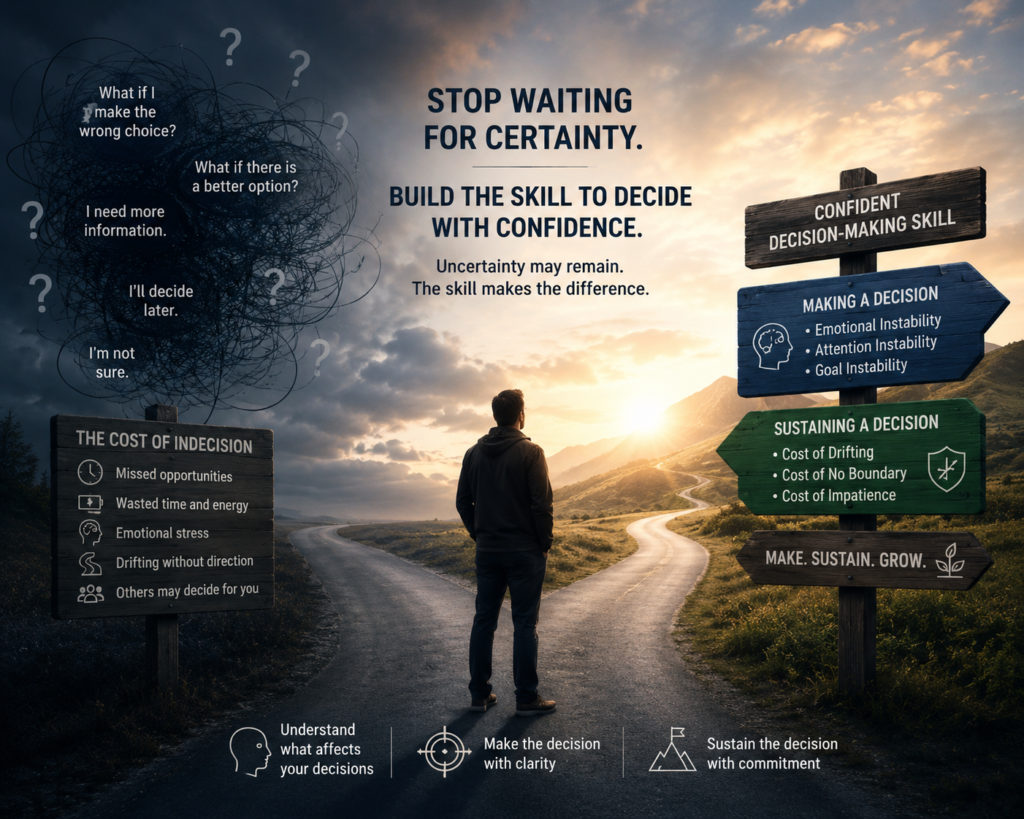
We make decisions every day.
Some are easy. What to eat. What to wear. Which route to take.
Others can change the direction of our lives.
Should I change my career?
Should I start a business?
Should I continue with this relationship?
Should I invest my money?
Should I move to another city?
Should I stay with a decision I have already made?
These decisions are different because certainty is rarely available.
And that is where many of us struggle.
We keep looking for certainty
When an important decision feels difficult, our natural response is often to gather more information.
We search online.
We ask friends.
We speak to experts.
We compare alternatives.
We think about possible outcomes.
And then we think about them again.
Sometimes this is useful. Information matters.
But there comes a point when we are no longer looking for information.
We are looking for certainty.
We want to know:
Will this definitely work?
Am I making the right choice?
What if something goes wrong?
What if there is a better option?
The problem is that many important decisions simply cannot provide those answers in advance.
The future is uncertain.
So if we make certainty a requirement for deciding, we can remain stuck for a very long time.
The cost of not deciding
Indecision can feel safe.
If I don’t decide, I haven’t made the wrong decision.
But not deciding is also a decision.
While we wait, opportunities can pass.
Our attention remains occupied.
Our emotional energy gets consumed.
Other people may continue influencing us.
And sometimes we drift into a situation without consciously choosing it.
This is one of the reasons Cost of Drifting is an important part of Confident Decision-Making Skill.
The question is not simply:
“What happens if I make the wrong decision?”
We should also ask:
“What is happening while I keep postponing the decision?”
Making a decision is only half the skill
There is another problem.
Sometimes we finally make a decision, but then struggle to sustain it.
A few days later, doubt appears.
Someone gives us a different opinion.
The expected result doesn’t arrive quickly.
Our emotions change.
Our attention moves somewhere else.
Our goals change.
And we begin questioning the decision again.
This is why confident decision-making cannot be limited to making a decision.
It also involves sustaining a decision.
These are two different skills.
Making a Decision
This involves understanding how:
- Emotional Instability
- Attention Instability
- Goal Instability
can affect our ability to make an important decision.
Sustaining a Decision
This involves understanding:
- Cost of Drifting
- Cost of No Boundary
- Cost of Impatience
and how these can affect our ability to stay with an important decision.
Confidence does not mean certainty
This distinction is important.
A confident decision-maker is not someone who knows exactly what will happen.
Nobody can know that.
Confidence in decision-making means being able to say:
“I don’t know everything that will happen. But I can make a considered decision and take responsibility for sustaining it.”
That is very different from certainty.
Certainty is about the future.
Decision-making skill is about how we respond to the future we cannot fully predict.
Decision-making is a skill
We spend years learning academic, professional and technical skills.
Yet most of us receive very little structured education about how to make and sustain the decisions that shape our lives.
We are expected to learn through experience.
Sometimes that experience is expensive.
A difficult career decision can cost years.
A poor financial decision can cost money.
An unresolved personal decision can cost relationships and peace of mind.
This does not mean every decision can be taught through a formula.
It means we can become better at understanding what affects our decisions and what makes it difficult to sustain them.
That is an educational gap worth addressing.
A better question
Instead of asking:
“How can I become certain before I decide?”
perhaps we should sometimes ask:
“How can I develop the skill to make and sustain this decision even though I cannot be certain?”
That shift changes the conversation.
We stop trying to eliminate something that may not be possible to eliminate.
And we start developing a capability that is actually within our control:
the skill of confident decision-making.
About Your Decision Coach Manoj Jain
I am Manoj Jain, Your Decision Coach, and I am working on making structured decision-making education simple, practical and accessible.
My work focuses on Confident Decision-Making Skill: developing the skill to make and sustain important decisions with confidence despite uncertainty.