
When Your Feelings Make the Decision for You
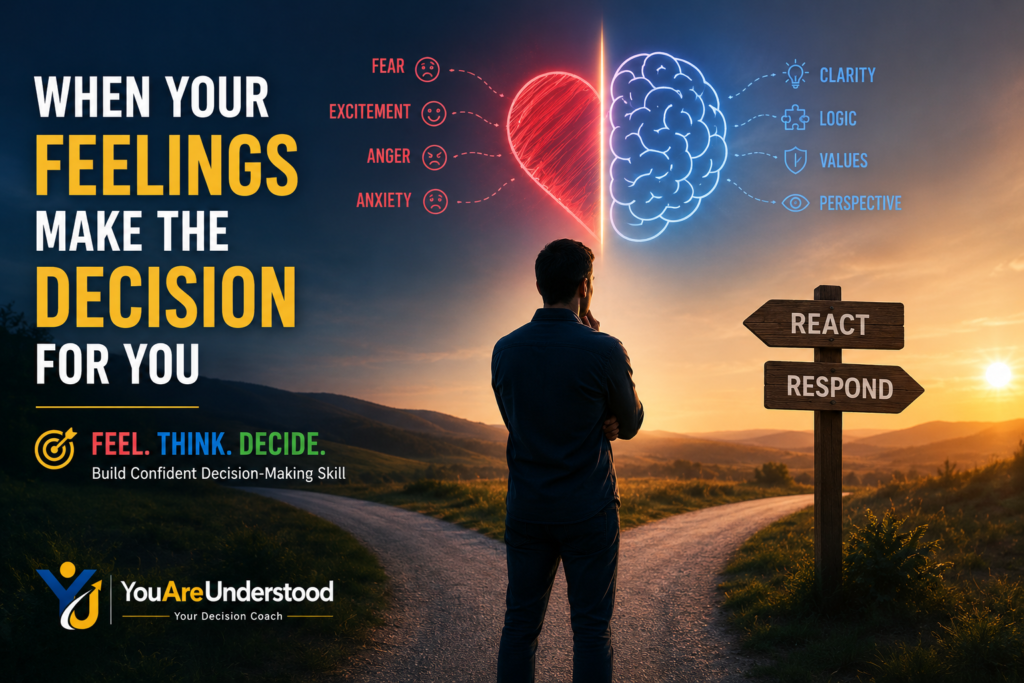
We often hear a simple piece of advice:
“Trust your gut.”
There is wisdom in that advice. Our feelings can give us important information. Sometimes we sense that something is wrong before we can clearly explain why.
But there is a problem when we confuse a feeling with a decision.
A feeling can inform a decision.
It should not automatically make the decision.
Feelings are real. But they are not always reliable instructions.
Imagine you are offered a new job.
You feel excited.
Does that mean you should accept it?
Not necessarily.
Perhaps the excitement comes from the salary. Perhaps from the recognition. Perhaps from the possibility of starting something new.
Now imagine another situation.
You receive an offer, but you feel anxious.
Does that mean you should reject it?
Again, not necessarily.
The anxiety could be telling you something important. Or it could simply be the discomfort that comes with uncertainty and change.
The feeling is real in both situations.
But the meaning of the feeling still needs to be understood.
That is where decision-making skill becomes important.
Fear can look like intuition
One of the biggest difficulties with emotional decision-making is that different emotions can produce similar conclusions.
Fear may tell us:
“Don’t do it.”
Excitement may tell us:
“Do it immediately.”
Anger may tell us:
“Walk away.”
Anxiety may tell us:
“Something is wrong.”
Sometimes those signals are useful.
Sometimes they are reactions to our previous experiences, assumptions, insecurity or the uncertainty of the situation.
If we automatically obey the feeling, we may never examine what is actually happening.
This is why emotional stability matters in decision-making.
Emotional stability does not mean becoming emotionless.
It means being able to experience an emotion without immediately allowing it to determine your action.
So should we ignore our feelings?
Absolutely not.
That would create another problem.
Your emotions are part of the information available to you.
If you feel uncomfortable about a decision, don’t dismiss it.
Pause and ask:
What exactly am I feeling?
Why might I be feeling this?
Is this feeling connected to something important in the situation?
Or am I reacting to uncertainty, fear or a previous experience?
These questions create a small but important space between feeling and deciding.
And sometimes that small space changes everything.
A simple four-step practice
When you are facing an important decision, try this:
1. PAUSE
Don’t immediately act on the strongest emotion.
Give yourself a moment.
2. FEEL
Identify what you are actually experiencing.
Are you afraid?
Excited?
Angry?
Confused?
Pressured?
Relieved?
Naming the feeling can help you understand it.
3. THINK
Now look beyond the emotion.
What actually matters in this decision?
What are the consequences?
What information do you have?
What remains uncertain?
4. DECIDE
Once you have considered what matters, make the decision consciously.
You may still feel uncertain.
That’s okay.
Confident decision-making does not require complete certainty.
The goal is not to choose between heart and mind
We often create a false choice:
Should I follow my heart or my mind?
I don’t think that is the real question.
Your feelings can provide information.
Your thinking can help you evaluate that information.
Your decision is the conscious choice you make after considering both.
So perhaps a better sequence is:
Feel. Think. Decide.
Not:
Feel. React. Decide.
There is a significant difference.
Decision-making is a skill
Most of us learn decision-making informally.
We watch our parents.
We learn from teachers.
We make mistakes.
We experience consequences.
We gradually develop our own way of making choices.
But important decisions affect our careers, relationships, finances, health, families and future.
Perhaps decision-making deserves to be treated as a skill that we consciously develop.
Not because we can eliminate uncertainty.
Not because we can guarantee perfect decisions.
But because we can become better at making and sustaining important decisions despite uncertainty.
That is the direction I am exploring through YouAreUnderstood.
The objective is simple:
Build Confident Decision-Making Skill.
Because your feelings deserve to be heard.
But you deserve to make the decision consciously.
One question to reflect on today
Think about an important decision you are currently facing.
Ask yourself:
“Am I making this decision, or is my current emotional state making it for me?”
You may find the answer surprisingly useful.
Your Decision Coach, Manoj Jain
YouAreUnderstood
Make Better Decisions. Live a Better Life.