
The More You Think About a Decision, the Harder It Can Become
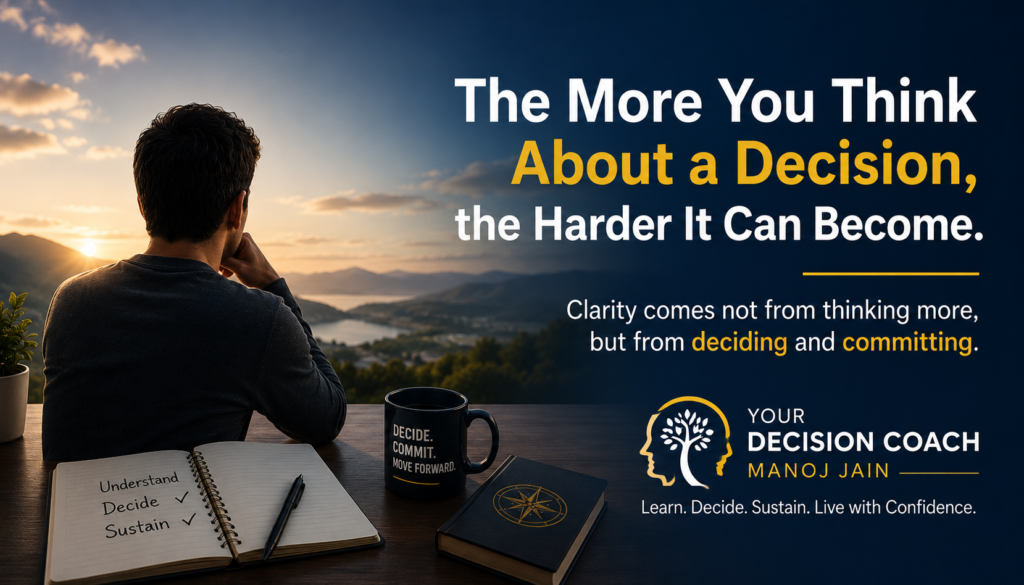
Have you ever spent days thinking about an important decision, only to find yourself even more confused?
You research.
You compare.
You ask people.
You watch videos.
You make a list of advantages and disadvantages.
And just when you think you are close to deciding, another question appears.
So you search again.
This can continue for days, weeks, or sometimes even months.
But there is an important question we rarely ask:
Are we trying to make a better decision, or are we trying to become certain before making the decision?
More information doesn’t always create more clarity
Information is useful.
If you are making an important decision, you should understand the situation as well as reasonably possible.
But information has a limit.
At some point, additional information may not reduce uncertainty.
Instead, it can create more possibilities to consider.
You discover another option.
Another risk.
Another opinion.
Another possible outcome.
And suddenly the decision feels even more complicated.
The problem may no longer be a lack of information.
The problem may be our inability to decide while uncertainty remains.
Why do we keep searching?
Because uncertainty is uncomfortable.
We want to feel that we have made the right choice before we commit to it.
We want someone to tell us:
“Yes, this is definitely the right decision.”
But important decisions rarely come with that guarantee.
There is no perfect information about the future.
There is no way to know every consequence before taking action.
And sometimes, waiting for certainty becomes a way of postponing responsibility.
Overthinking can become a form of drifting
There is a difference between thoughtful reflection and endless reconsideration.
Thoughtful reflection helps us understand.
Endless reconsideration keeps the decision open.
And when a decision remains open for too long, something else happens.
Our attention remains occupied.
Our emotional energy gets consumed.
Time passes.
Opportunities change.
We may eventually find ourselves moving in a direction without consciously deciding to do so.
That is one form of the Cost of Drifting.
The cost isn’t always dramatic.
Sometimes it is simply the accumulated cost of time, attention and energy spent without a clear direction.
So what should we do?
The answer isn’t:
“Stop thinking.”
Nor is it:
“Make decisions quickly.”
The better question is:
“Have I gathered enough information to make a considered decision, or am I continuing to search because I want certainty?”
That distinction can change the way we approach important decisions.
Once we recognize that certainty is unavailable, we can begin working on a different skill:
the ability to make a decision despite uncertainty.
And after making it, another skill becomes important:
the ability to sustain that decision responsibly.
Decision-making is a skill
We spend years developing professional and technical skills.
Yet very few of us receive structured education on how to make and sustain important decisions.
We mostly learn through experience.
And experience can be expensive.
Perhaps decision-making deserves to be treated as a skill that can be understood, practiced and developed.
Not so that we can predict the future.
But so that we can respond to an uncertain future with greater confidence.
A question for you
Think about one important decision you are currently postponing.
Ask yourself:
“Am I still looking for information, or am I actually looking for certainty?”
The answer may tell you something important about what is keeping you stuck.
Your Decision Coach Manoj Jain
I am working on making structured education around Confident Decision-Making Skill simple, practical and accessible.