
Making a Decision Is Only Half the Work
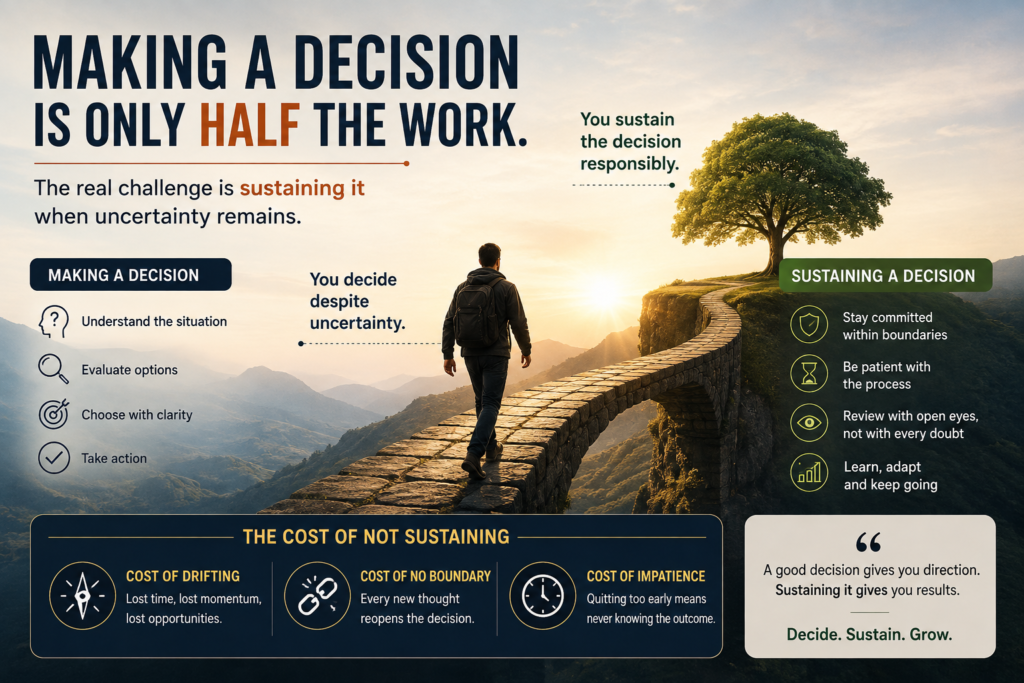
Making a Decision Is Only Half the Work
We often think the difficult part is making a decision.
Should I take the new job?
Should I start the business?
Should I move to another city?
Should I continue with this relationship?
Should I invest in this opportunity?
We spend days, weeks, sometimes months trying to arrive at the right answer.
And when we finally decide, we feel relieved.
But then something interesting happens.
The decision starts becoming difficult again.
A few days later, doubt appears.
Someone gives us a different opinion.
The expected result doesn’t arrive.
Our emotions change.
A new opportunity appears.
We start asking ourselves:
“Did I make the right decision?”
And slowly, we begin moving away from the decision we had already made.
Making a decision doesn’t mean uncertainty disappears
This is an important distinction.
When you make an important decision, you don’t suddenly gain complete knowledge of the future.
You still don’t know exactly what will happen.
You may have made the best decision you could with the information available at that time, and yet the outcome may remain uncertain.
So the question after making a decision is not always:
“Can I become certain that this was the right decision?”
Sometimes the better question is:
“Can I develop the skill to sustain this decision responsibly while uncertainty remains?”
That is a very different question.
Why do we abandon decisions?
There are many reasons.
Sometimes our emotions change.
Something that felt exciting yesterday may feel frightening today.
Sometimes our attention changes.
We discover a new article, hear someone’s opinion or notice another opportunity, and suddenly our original decision doesn’t feel as attractive.
Sometimes our goals change.
What we wanted six months ago may no longer be what we want today.
And sometimes we simply become impatient.
We expected results quickly.
They didn’t arrive.
So we conclude that the decision must have been wrong.
These are not necessarily signs that the original decision was bad.
They may simply indicate that sustaining a decision is itself a skill.
The cost of drifting
Consider a simple example.
Someone decides to spend the next two years building a business.
They begin working.
Three months later, there are no significant results.
They become uncertain.
A friend suggests taking a job.
They start considering it.
Another person suggests a different business.
They start researching that.
A few weeks later, they are doing neither.
They haven’t necessarily made a new decision.
They have simply started drifting.
And drifting has a cost.
Time passes.
Attention gets divided.
Energy gets consumed.
Progress becomes difficult to measure.
Eventually, the person may look back and realize that the biggest problem wasn’t necessarily the original decision.
It was the inability to sustain a direction long enough to learn from it.
This is why Cost of Drifting is an important part of Confident Decision-Making Skill.
Boundaries matter
Sustaining a decision doesn’t mean blindly sticking with it forever.
That would be another mistake.
Important decisions need boundaries.
For example:
- What exactly have I decided?
- What am I committing to?
- What am I not committing to?
- Under what circumstances will I review the decision?
- When will I evaluate progress?
Without boundaries, every new thought can reopen the decision.
Every new opinion can create doubt.
Every temporary emotional change can become a reason to reconsider.
This is the Cost of No Boundary.
A decision that can be reopened every day is difficult to sustain.
Then comes impatience
Perhaps the most common problem is impatience.
We make a decision.
We expect movement.
Nothing seems to happen.
We become uncomfortable.
And we start thinking:
“Maybe this isn’t working.”
But some decisions need time before their consequences become visible.
If we abandon every decision before giving it enough time to produce meaningful evidence, we may never know whether the decision could have worked.
This is the Cost of Impatience.
Patience doesn’t mean refusing to change.
It means giving a decision enough space and time to generate useful evidence before abandoning it.
Sustaining doesn’t mean stubbornness
This distinction is extremely important.
Sustaining a decision is not the same as defending it at all costs.
If new evidence fundamentally changes the situation, a responsible person should be able to reconsider.
The skill is not:
“Never change your decision.”
The skill is:
“Don’t change your decision merely because uncertainty, discomfort or impatience appeared.”
That difference matters.
Two skills, not one
This is why I see confident decision-making as involving two essential skills:
1. Making a Decision
Developing the ability to make an important decision despite uncertainty.
2. Sustaining a Decision
Developing the ability to stay with that decision responsibly while uncertainty remains.
The first gets you moving.
The second gives your decision an opportunity to work.
Ask yourself one question
Think about an important decision you have already made.
Ask yourself:
“Am I reconsidering this decision because something genuinely changed, or because I became uncomfortable with uncertainty?”
That one question can create a useful pause.
Because sometimes the problem isn’t that we made the wrong decision.
Sometimes we simply haven’t developed the skill to stay with a decision long enough to find out.
About Your Decision Coach Manoj Jain
I am Manoj Jain, Your Decision Coach, working on making structured education around Confident Decision-Making Skill simple, practical and accessible.
The objective is straightforward:
To build the skill to make and sustain important decisions with confidence despite uncertainty.